There is a distinct difference between decorating a room and curating a collection.
When it comes to Western art, the frontier is too often romanticized through predictable clichés: a lonely cowboy riding into a sterile sunset, a static log cabin nestled in the mountains, or a formal, stiff portrait of a historic figure. But seasoned collectors—those who treat art not as mere wallpaper, but as an emotional investment and an extension of their own identity—know that the true spirit of the American West cannot be found in mass-produced tropes.
The West was never a quiet, static place. It was a frontier forged in the crucible of violent movement, grit, dust, and the incredibly delicate balance between human discipline and untamed nature.
When you walk into a space featuring a true masterpiece of Western art, you shouldn’t just see a beautifully rendered subject. You should feel a physical shift in the atmosphere of the room. You should hear the chaos, smell the ozone in the air before a storm, and feel the tension of a moment where life hangs in the balance.
The Connoisseur’s Eye: Beyond Nostalgia and Into Kinetic Energy
For decades, Western art has maintained one of the most loyal, robust, and financially resilient sectors in the global fine art market. From the historic auctions in Scottsdale and Santa Fe to the prestigious galleries of New York and Europe, the demand for high-quality Western imagery never truly fades. Why? Because it taps into a universal human desire: the yearning for raw freedom, rugged individualism, and uncompromising authenticity.
However, as a collection matures, a connoisseur’s criteria undergoes a profound evolution. A beginner looks for basic historical accuracy or a pleasing color palette that matches the furniture. A true collector looks for something far more elusive: soul and kinetic energy.
The most valuable pieces in a private gallery are those that manage to capture what master painters call the living line. This is the rare ability to freeze a chaotic, high-speed action on canvas without making it look dead, clinical, or artificial. When an artist achieves this level of mastery, the painting ceases to be a static arrangement of pigment on fabric; it becomes a perpetual engine of movement.
When a seasoned collector evaluates a high-end Western painting, they are looking for specific psychological triggers:
- The Weight of the Dust: The dust on the canvas shouldn’t look like a flat cloud; it must feel like a swirling, choking vortex kicked up by thundering hooves, blurring the lines between the animals and the earth.
- Anatomical Tension under Stress: Every muscle in the horse’s shoulder, every ripple of tension in the rider’s posture, and the desperate weight of the livestock must be anatomically accurate yet subtly charged with dramatic exaggeration to convey force.
- The Anticipation of the Next Second: A phenomenal painting doesn’t just show you what is happening right now; it forces your brain to anticipate what will happen in the very next millisecond. It locks the viewer into a beautiful, permanent state of suspense.
This is the psychological magnetism of high-end Western art. It provides a visual escape—a daily, powerful reminder of a world where life is lived with absolute intent, where actions have immediate consequences, and where every split second counts.
The Illusion of Geography: A Global Equestrian Brotherhood
One of the most fascinating developments in the modern fine art world is the realization that the Western spirit is not confined to a specific geographic coordinate or a single line of latitude. The traditions of the saddle, the deep-rooted, almost telepathic bond between a horse and its rider, and the raw adrenaline of working livestock are universal languages spoken across the globe.
To truly appreciate the depth of Western art, one must understand that the iconic imagery of the American West has deep, transnational roots. The archetype of the cowboy did not magically appear in Texas, Wyoming, or Montana during the 19th century. Its foundations were poured centuries earlier in the Iberian Peninsula.
It was the Spanish horsemen who introduced cattle, horses, and specialized roping equipment to the Americas in the 1500s. As these traditions spread across the vast landscapes of the New World, they adapted to different environments, creating a rich tapestry of equestrian cultures:
- The Vaquero: The original master of the lasso, developing unparalleled roping skills and horse-training philosophies in Mexico and California.
- The Cowboy: The northern adaptation, fusing Vaquero techniques with Anglo-American ranching styles to manage the massive cattle booms of the plains.
- The Llanero and Gaucho: The fierce, independent cattlemen of the South American plains, who lived by the exact same codes of grit, survival, and horsemanship.
Because of this shared heritage, the spirit of the frontier belongs to whoever is willing to study it, honor it, and paint it with uncompromising authenticity. A piece of art doesn’t need to be painted in a studio in Wyoming to be a legitimate masterpiece of Western art. In fact, some of the most compelling perspectives come from artists who view the West through a global lens, recognizing that a cowboy leaning hard over a galloping horse represents a universal human triumph over chaos—a story of discipline meeting danger that resonates just as deeply in Central America as it does on the plains of North America.
Why Photography Fails Where the Brush Succeeds
We live in an era dominated by instant digital imagery. A modern high-speed camera can easily shoot dozens of frames per second, freezing the motion of a flying lariat or capturing the exact pixel-perfect texture of a horse’s flying sweat. Yet, if you walk through the homes of serious art collectors, you will rarely see these high-speed digital photographs framed as the centerpiece of a luxury living space or a corporate boardroom.
The reason is simple: a photograph documents a historical fact, but a painting captures an emotional truth.
A camera captures a cold, clinical fraction of time ($1/2000$ of a second) by mechanically cutting off the past and the future. It isolates the image in a way that often drains the life out of the movement, making a running horse look as though it is floating awkwardly in mid-air.
Painting, however, operates on a completely different dimension of time. A painter does not simply copy a single freeze-frame. Instead, the artist condenses hours of observation, years of technical muscle memory, and the emotional memory of a thousand different cattle drives into a single, unified composition.
- The Brushstroke as Energy: Every stroke of the brush carries the physical weight and speed of the artist’s hand. A fast, aggressive sweep of a dry brush across the canvas doesn’t just look like dust—it is the visual record of a fast, aggressive human movement, mirroring the speed of the horse itself.
- The Mastery of Light (Chiaroscuro): While a photographer is often at the mercy of natural sunlight, a painter acts as a director of theatrical lighting. The artist can selectively deepen the shadows under a cowboy’s hat to emphasize mystery and focus, or heighten the golden highlights on a horse’s coat to create a dramatic contrast against a bruised, threatening storm sky.
- The Compositional Flow: A master painter designs the lines of a canvas to guide the viewer’s eyes in a specific, rhythmic sequence. The curve of a rope, the angle of a horse’s neck, and the desperate lean of a steer form an invisible geometric circuit. Your eyes travel across the canvas over and over again, experiencing the physics of the chase dynamically every single time you look at the wall.
This is why fine-art paintings hold their value across centuries. They do not age the way technology ages. A photograph from twenty years ago looks dated; a powerful acrylic or oil canvas capturing the raw energy of the frontier remains timeless, vital, and endlessly captivating.
The Centerpiece of a Collection: Designing Around Power
A true fine-art piece is not passive. It doesn’t blend seamlessly into the background or politely apologize for taking up space. It demands a dedicated wall, precise accent lighting, and an appreciative, contemplative gaze. It is an anchor for an entire room, dictating the energy, the color palette, and the mood of the architectural space around it.
When designing a premium living space, a library, or an executive office around Western art, interior designers and collectors look for pieces that possess a commanding scale and a strong tonal contrast. A painting with a powerful narrative element acts as an instant conversation piece, bridging the gap between historical reverence and contemporary luxury.
Imagine walking into a beautifully curated room lined with warm marble, rich wood accents, or classic architectural molding. If you place a soft, generic landscape on the wall, the room remains polite and quiet. But if you place a painting that crackles with the energy of a high-stakes roping action—where a horse is charging forward and a lasso is hovering in mid-air—the entire room suddenly wakes up. It introduces an element of vitality, strength, and raw human determination that commands respect from anyone who enters.
For the serious collector, the acquisition process is an emotional hunt. You are constantly searching for that rare work that stands out from the endless sea of ordinary illustrations. You are looking for the piece that makes you stop mid-stride in a gallery, the one that causes your pulse to quicken, and the one that stays embedded in your imagination long after you have turned your back and walked away from the wall.
A Piece for Your Consideration: «Lazo y Tormenta»
If you are a collector who bypasses the ordinary, someone who values the raw, unfiltered power of the frontier over predictable, stagnant landscapes, there is a specific work currently available that deserves your undivided attention.
«Lazo y Tormenta» (Lasso and Storm) is an extraordinary original fine-art painting that perfectly exemplifies this balance of discipline, kinetic motion, and atmospheric drama.
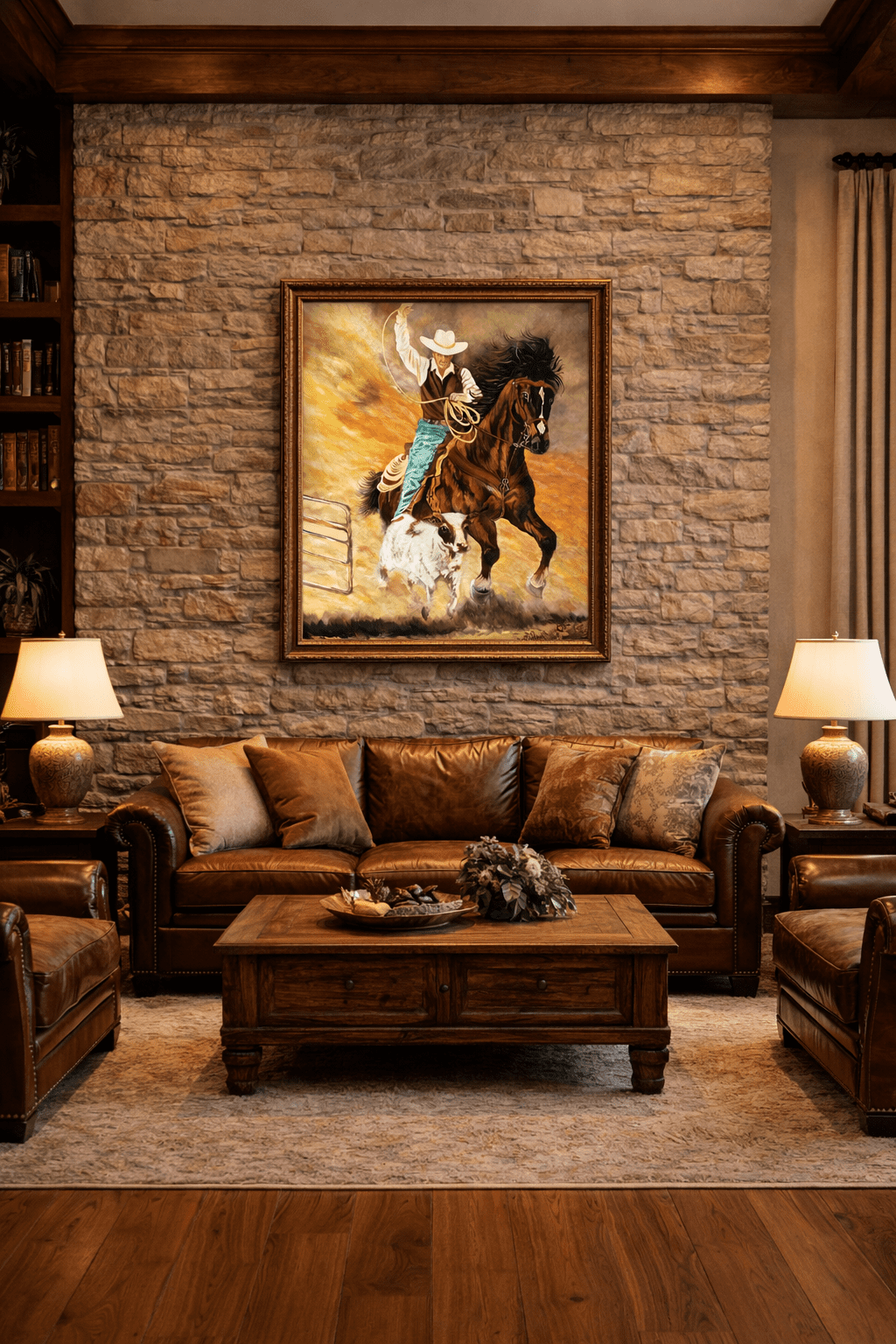
Instead of presenting a distant, detached view of ranch life, this commanding composition brings the viewer directly into the epicenter of the action. It captures the absolute peak of tension: a master horseman fully synchronized with his powerful bay mount, charging forward through an exploding vortex of golden dust, while a wide, tense lasso is suspended high in the air against a heavy, bruised storm sky. Just beneath the horse’s chest, a spotted steer plunges forward, creating a brilliant, high-contrast focal point of pure adrenaline.
Painted with the decisive urgency and rich texture that only a master of the acrylic medium can achieve, «Lazo y Tormenta» is not merely a depiction of a traditional ranch chore—it is an epic visual narrative of human determination defying the elements. It is a piece engineered specifically for a collector who wants to feel the thunder of hooves and the electric charge of a coming storm every time they glance at their gallery wall.
For those who appreciate original Western art at its highest emotional caliber, «Lazo y Tormenta» may very well be the defining centerpiece your private collection has been waiting for.
Please inquire about the artwork’s availability and details.
Below is an example of how it could look on a specific wall.